Showing posts with label handspinning. Show all posts

7 Sept 2013

Corespun Yarn with Ribbon Rose Inclusions

One thing I like about corespun yarn is how easy it is to include small items like beads or flowers.


Today it's about flowers.  How decadent, to have these little beauties interspersed throughout your work, whatever your fibre art of choice happens to be.  Being in the mood for reds lately, I combed out a selection of red fleeces into some lovely top.  


So what's the story on this selection of top?  This past summer when I was down home in Nova Scotia I bought a lovely Romney x Lincoln Longwool fleece at Aspen Grove Farm outside Bridgewater. Very lustrous and curly.  I dyed it mostly in different reds and one fuchsia because, hey, how can you not dye something fuchsia?  It took the dye beautifully.  This skein includes all those reds and pinks from the Romney/Lincoln fleece, plus a bit of Corriedale.  So it won't be a soft and fluffy yarn, but it will be lustrous and textured.


Because I didn't want to blend all those lovely reds together (although in these photos they seem to look more pink than red - you'll just have to trust me on this) but wanted each colour to speak its own voice in some random fashion, I prepared my top for spinning by laying out a strip of each colour on my lap ... 


... and drafting it out into a long cord (strip? I'm not so great at the proper vocabulary, here) of top.  So there is some colour intermingling, and some striping of one colour after another.  

Next for the flowers to include in the yarn:
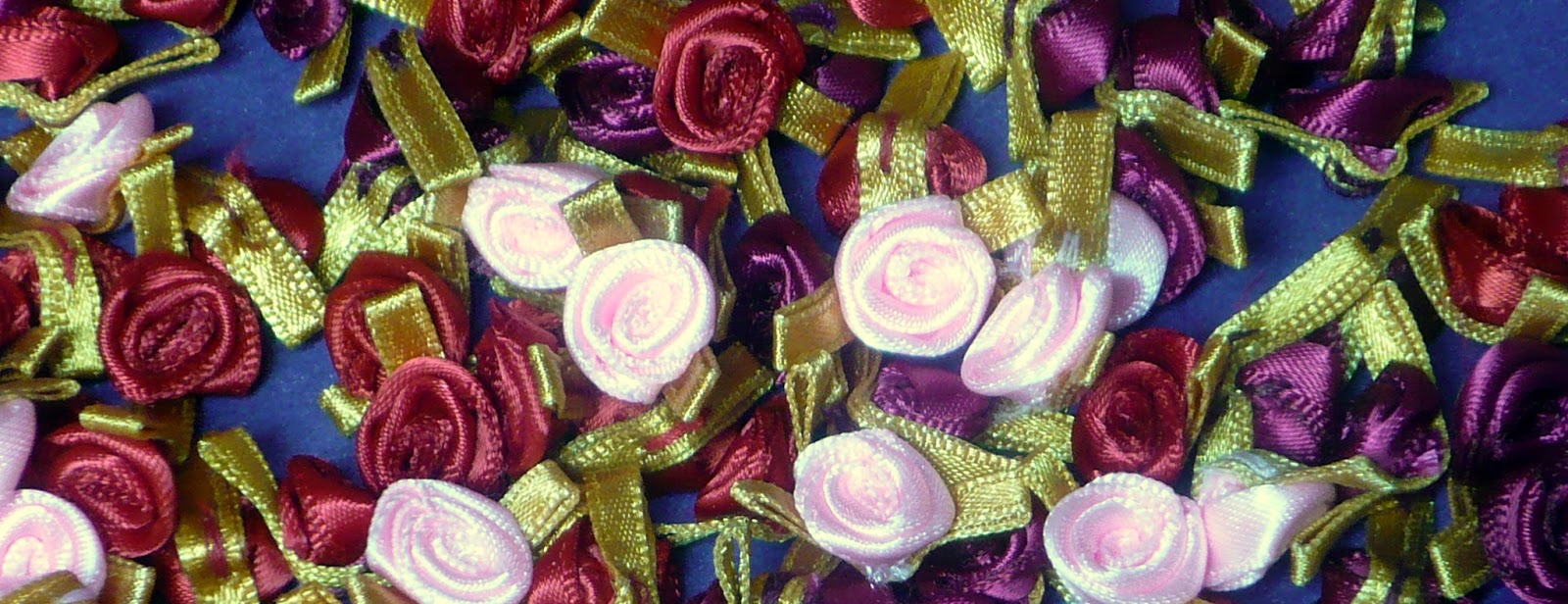


I buy these ribbon roses from Laurl on Etsy.  This small size fits easily through the orifice on my wheel and doesn't get caught in the hooks.  There are larger ribbon flowers available that can be fed through the orifice with lots of care and patience, and although I have at times in my life had sufficient emotional wherewithal to calmly, gently, and successfully ease large ribbon flowers through my wheel workings, this is not something I reliably have in vast quantities, nor do I want to spend it all on my yarn in case that means I'm going to have a complete meltdown later in the day when I burn supper or break my favourite mug.  We live our lives and do what works best, right?  For me, sticking to smaller, more easily dealt-with flowers is the road I have chosen.  My advice is, before starting a project like this, make sure whatever it is you're spinning into your yarn will fit through your orifice and hooks, and consider how willing you're going to be to nurse the yarn along if it's a close fit.


I spun a small sample skein just to see how the colours would play out with the whole hand-drafting the top together method, and also to help me pick what colour flowers I wanted to use.  I think any of these would be nice, but I wanted the flowers to stand out.


Here's my practice skein still on the wheel -- you can see drafting the top as I did worked just fine, and I have random sections of different reds all throughout my yarn ...


... and here are my rose colour choices.  Sadly, the light pink one didn't focus very well, but I think it will stand out best against the reds, and that's what I'm going with.


First step is to thread the roses onto a spool of strong nylon beading thread.  This thread will be strung alongside my strong cotton core in the yarn.


The roses are sewn together across the back, making an ideal spot to run the needle to thread the roses onto the nylon, i.e., between the "leaf" ribbon and the "blossom" ribbon, within the bounds of that stitch.  I took some fabulous shots of the pink flowers being strung onto the nylon.  What in the world happened to them?  I have no idea.  But they've completely disappeared so you're just going to have to use your imagination here.


Now I'm set up for spinning.  Next to me I have a bin with my cotton core (embroidery cotton #10), and another bin with my nylon beading thread.  My comments on this set-up are as follows:

1. You don't need to use two cores.  You can thread all the flowers onto the cotton core.  However, it's a thicker thread and not as slippery, so you have to take more care putting your roses on and sliding them along as you're spinning -- which is okay, I've done it successfully and it's not a terrible drag. It's just easier and smoother with nylon.

2. I thread all the flowers on at once, sliding them a few metres down the thread.  Then I spread out the first five or so flowers where I want them along the nylon.  They tend to stay where I want them, so it's a convenient way to keep track of how far apart they are in the yarn.  I've tried spacing all the flowers out at once, and wound up with a gigantic tangle of nylon in the bin, so just doing a half-dozen or so at a time seems to be the answer for me.  You can see in the photo above, one pink rose hanging on the nylon thread, making its way up towards the wheel to be spun into the yarn.

3. One of the best online tutorials for corespinning yarn that I have seen is by Esther Rodgers of Jazz Turtle.  This is a good video for showing how to start your corespun yarn and introduce the core threads to get going.

4.  Why do I use these ugly plastic bins?  I know.  They're not at all handmade or attractive or anything inspiring creativity.  Here's the thing.  Handmade baskets are tremendously beautiful.  I love them.  But they catch and pick at my materials as I'm spinning, which is not only frustrating but can cause damage.  There are lovely felted baskets which wouldn't do that, but the reality of my life is that I use almost exclusively handprocessed fleece in my yarns.  That means I'm doing a lot of combing and carding, and no matter how much vacuuming and sweeping I do in my craft room, there's always a film of VM (dried crumbs of plant matter) on my floor.  I don't want to even think about what that would do to a lovely felted basket.  Plus I need bins for tons of reasons, including holding uncombed (VM-laden) fleece.  And the ugly plastic ones wipe out easily, are stackable, and sturdy enough that they can hold that huge cone of embroidery cotton in the same place as it's rolling around.  So I forego the aesthetic qualities of more attractive baskets as worktools in this particular situation.


So here we are, corespinning along.  I've just lifted my thumb back to show how I keep the core threads stable in my hand by running them under my ring finger.  My pointer finger smooths the wool around the core as I'm spinning along.


When I get within a few inches of a rose, I stop spinning and slide the flower up the thread to meet the end point of my yarn.  Here I'm holding the two core threads (cotton and nylon) separate, just for the sake of the picture.  When I'm actually spinning, I hold them together.


Fit the rose right up against the wool, treadle once ... 
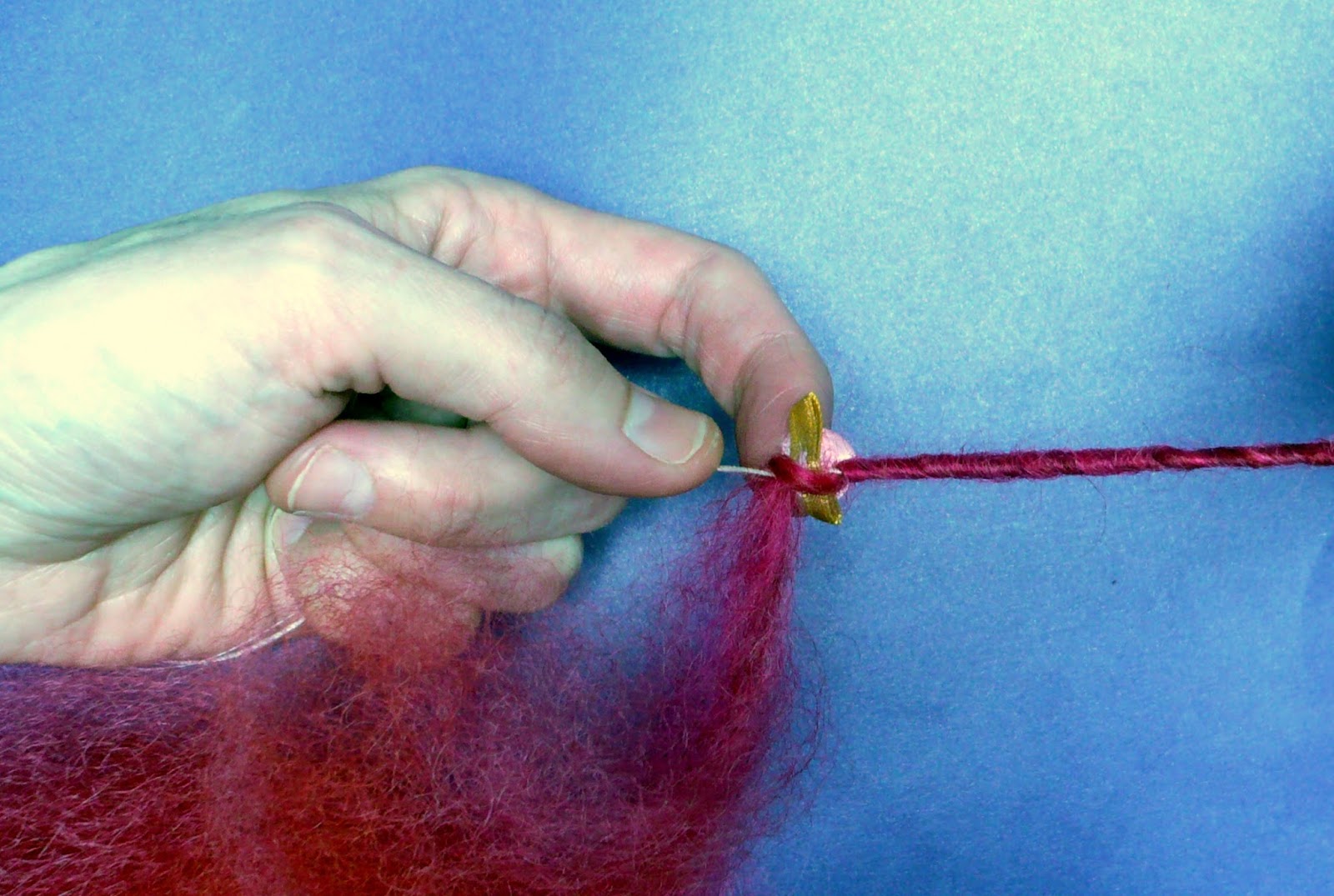


... which wraps the wool around the back of the flower ... 


... and spin on down the core.  Keep an eye on the rose as you continue to spin.  Hopefully it should feed easily through your orifice and onto your wheel, but depending on your wheel it may need a hand -- you'll know right away, because the yarn will stop feeding onto the bobbin.  Just stop spinning, ease the flower through, handwinding it onto the bobbin if necessary, and continue on your way.


Here's a photo of the final yarn, which, taken in my homemade lightbox, shows something much more RED than the pinkish colours above.  It really is these reds, and not those pinks, which teaches us all something about how unreliable cameras are for showing us what anything actually looks like.  Now that's deep.


See this yarn in my ETSY SHOP

Here are some other ribbon rose yarns I've spun - this first one corespun with uncarded locks dyed green, so there's lots of texture and curl.


Available in my ETSY SHOP


In my ETSY SHOP

 In my ETSY SHOP


This was the last skein I spun using larger flowers.  They do look marvellous, and maybe someday when I get my dream larger-orificed Country Spinner, I'll go back to including these flagrant beauties...

2 Aug 2013

Two Art Yarns (with Grannie Stacks) from One Batt -- Colour Matching

Because I often get different ideas for yarns as I put colours together for a batt, I enjoy carding a few batts with the same colours and then spinning a couple of my ideas to see how they'll turn out and compare.  I can never spin ALL my ideas, but maybe that's a good thing. 

Sometimes it's fun to start a story at the end, so here is what I got from this particular set of batt ideas.  One ply from each of these yarns has been spun from the same multicoloured batt.  I chose different colours for the second ply, creating two completely different looks:


If you look closely, you'll see that each of these yarns has intermittent "grannie stacks,"
or piled-up twists of yarn, throughout.  These add concentrated colour, texture,
and definition to the yarn, and they just make me happy.
I was in the mood for yellow/peach/orange/pink, and I assembled different wools from my dyed stash and combed and carded them up.  This is what I came up with -- I didn't use a whole lot of the darker orange, in the end.  I'm hoping the picture reveals not only the colour differences but suggests the texture differences as well.


Fibre includes Cormo, Corriedale, Mohair, Merino, Romney x Bluefaced Leicester,
Border Leicester x Bluefaced Leicester, Lincoln Longwool,
and a bit of BLFxSilk top that I had leftover from another project
All spun up into my first single, it came together something like this:


Naturally, and true to my general way of doing things, I next forgot to photograph my lovely assembly of purples from which I spun another single to ply with the first.  And a "single" or "singles," dear non-spinning friends,  is one single strand of yarn made from twisted together fibres as is, without wrapping anything around it, just on its own.  For this yarn, I'm taking two singles and twisting them together, or "plying" them, to make a two-ply yarn.

I did manage to remember to take a photo of me making the second single, though, and you can get some idea of the different purples that went into it from the carded batt I'm spinning from -- well maybe if you enlargen the pic by clicking on it.


Here are the two singles before plying.


This yarn -- my inspiration for the two yarns I'm talking
about now -- is from a previous blog entry,  
HERE
and you can find it in my Etsy shop HERE


What I decided to do was spin two-ply yarn with beehive grannie stacks, similar to the yarn on the right, but instead of those long even coils of colour, there would be stacked-up coils, and instead of using the multicoloured single for the stacks, I'd use the solid-coloured one.


So here I am plying the two singles, or twisting them together (in the opposite direction to that in which they were first spun).  I hold the two singles tautishly out ... 


... and then slide my hand up, allowing the wheel to twist them together.


After every three lengths of regular plying, I put in a grannie stack.  This is wrapping one ply (in this case, the purple one) around the other in the same small area, creating a little stack, and then continuing to ply normally.  So here I'm getting ready to make my stack, holding the purple single out to the side ...


... then I let the wheel spin it around in the same spot, angling my purple ply up and down a bit to spread out and stack the yarn.  I'm holding the other single way back with my other hand, because as I twist and wrap the purple single around the other single, the other single is untwisting, and if it untwists too much it will pull apart.  By holding it further back, I'm distributing the "untwist" over a greater length of yarn.


When I'm happy with my little grannie stack, I continue plying normally.  


Here it is on my spindle


My high-tech lazy kate is there on the floor.  A lazy kate is a contraption that holds your spindles
full of yarn and allows you to unwind them as you ply.  There are some
very gorgeous ones out there that you can buy.  This one is made from a cardboard box
with a couple knitting needles punched through the walls.  My spindles fit perfectly
on the needles.  The biggest trick is remembering WHERE the needles are when you want
to knit something with them.

And all finished.  The little stacks will make little purple shouts of colour in whatever it's used for.


You can see this in my Etsy shop HERE

For the second skein, I wanted to ply with yellows.  I used the same yellows that were in the multicoloured single - here they are again:


Carded into a batt and spun in the same way as the other yarn, this time with yellow grannie stacks, it came out like this:


This is also in my Etsy shop HERE


Changing the colour of the second single really makes a big difference in the overall look of the yarn.  If I'd had enough of those multicoloured batts, I would have plied another skein with peach/orange, and yet another with pinks.  Ah, so much to do, so little time...


Check it out in my Etsy shop


Check it out in my Etsy shop


13 Jul 2013

Two More Art Yarns from One Batt

So I was in the mood for a yarn that was plied, with regular little beehive-y type exclamations throughout.  Something with lots of colours, and plied with something solid for nice contrast.  Something like (actually exactly like) this:


But I also wanted to do something else, that would look completely different, with the same batt.  Something that wound up looking exactly like this:


Still in my purple celebration, I made another selection of colours including much purple, but venturing into other colours freely, and wound up with these -- you can see I'm still using the natural greys as well:


Most of these are my own hand combed or carded fibres, there's a little commercial top in there (which means a mill prepared the wool).  It's all dyed by me. I just dye and dye what I feel like and maintain a stash of colours to spin from.  

So I carded four batts, two for each skein, which as always you can't really appreciate from so far away as your computer screen, but this is something like what they looked like:


So first up is the two-ply yarn.  I spun the multicoloured single


and I decided to use a bright fuchsia-red Wensleydale top I had dyed some time ago for the other ply.  I thought it would look great with the colours in the batt, and really make the pinks stand out. This pic (at least on my monitor) has captured a bit of the textures of the different wools.


Wensleydale is a long-stapled fibre and spins into a wonderfully smooth, thin single. Not especially soft, but lustrous.  You can tell this top was mill spun, it's so tight and perfect.  My top is looser (well, easier to spin from too) and I treat it more carefully so it doesn't fall apart before I'm ready for it.  Commercial top can withstand a beating and it still holds together.


Here are my two lovelies, waiting to be married.


  So I plied them together ...


... and every here and there I put a little beehive, just pushing the multicoloured strand up and packing the coils together every 30 inches or so.


And then all finished


I like these colours - very circussy.  I like how the pink brings out the other colours.

And now, having made this beautiful colour combination, I wanted to corespin something as well, just to enjoy the colours differently, without the interplay of the pink Wensleydale.


So here I'm corespinning the wool, which is basically wrapping wool around a core, which in this case is no.10 crochet cotton.  It wraps on at a sharp angle and shows the colours a bit differently than with regularly-spun yarn.


So in the end


It really looks different than the plied yarn, even though the batts they started as before spinning were pretty much the same.  Here's a final look:


A pretty hefty skein of yarn, weighing in at 235 g (8.3 oz) 112 m (123 yards) long and bulky at 5-6 wpi
You can see it in my shop HERE
This skein turned out a lot smaller than the other one, as I only used the two coloured batts
without the addition of the Wensleydale - 60 m (66 yards), 98 g (3.45 oz) and aran weight, wpi 8
You can see it in my shop HERE