Showing posts with label coiled yarn. Show all posts

21 Oct 2013

Using Art Yarn - the Fate of my Little Ones

Something I love about spinning is imagining what might be happening to my yarn after I send it out into the world.  Most of the time I never find out, and am left to ponder its fate -- was it made into a beloved garment?  Put away with the best of intentions and then forgotten about?  Discarded immediately with an embarrassed shrug?  I can't help wondering!  

Every now and then someone will send me a picture to share what they've done, though, and I can't exaggerate what a thrill that is. 

A year or two ago I was contacted by Mark Sloniker, an artist on Etsy, with a request for some supercoil yarn.  I love to make supercoil, although it's time-consuming.  It involves spinning a long, thin single, then plying it with another single or "core thread" by wrapping it pretty much at 90 degrees so as to encase the other single (like a core) with a long coil of yarn.  I discussed this process more, with illustrations, previously in my blog.


Example of supercoil yarn: I love the look and feel of these!

Mark had a particular project in mind -- a tree stump -- and asked for specific colours.  After getting his approval on the dye job I did on the wool -


Merino commercial top hand-painted with acid dyes

As the fibres are drafted apart for spinning, the colours fade and blend


I spun the yarn -


This totalled about 56 yards of supercoil yarn


Not long ago I heard back from Mark, who not only finished his truly gorgeous tree stump - as you can see below - 
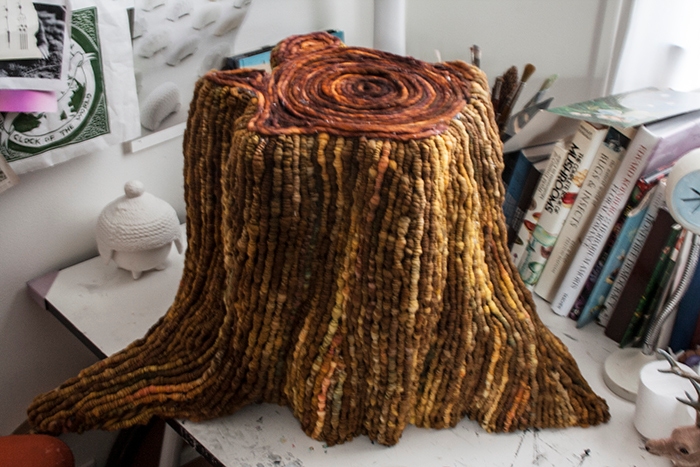

You can read about how Mark made this fabulous piece on his blog
but used it as part of a set for illustrations to a children's book he has written, called Search for the Sugar Puff Hollow, available in his Etsy shop. 


 A pic from Mark's blog about the book -
love the critters, and hey, there's my yarn in the background!

There are tons of behind-the-scene photos of the making of this beautiful book on Mark's blog HERE.

So a totally exciting story of some yarn that has gone on to make me proud! I'm humbled by his amazing creativity.

In the meantime, I keep spinning...


I always try to keep a few skeins of supercoil in my Etsy shop...


2 Aug 2013

Two Art Yarns (with Grannie Stacks) from One Batt -- Colour Matching

Because I often get different ideas for yarns as I put colours together for a batt, I enjoy carding a few batts with the same colours and then spinning a couple of my ideas to see how they'll turn out and compare.  I can never spin ALL my ideas, but maybe that's a good thing. 

Sometimes it's fun to start a story at the end, so here is what I got from this particular set of batt ideas.  One ply from each of these yarns has been spun from the same multicoloured batt.  I chose different colours for the second ply, creating two completely different looks:


If you look closely, you'll see that each of these yarns has intermittent "grannie stacks,"
or piled-up twists of yarn, throughout.  These add concentrated colour, texture,
and definition to the yarn, and they just make me happy.
I was in the mood for yellow/peach/orange/pink, and I assembled different wools from my dyed stash and combed and carded them up.  This is what I came up with -- I didn't use a whole lot of the darker orange, in the end.  I'm hoping the picture reveals not only the colour differences but suggests the texture differences as well.


Fibre includes Cormo, Corriedale, Mohair, Merino, Romney x Bluefaced Leicester,
Border Leicester x Bluefaced Leicester, Lincoln Longwool,
and a bit of BLFxSilk top that I had leftover from another project
All spun up into my first single, it came together something like this:


Naturally, and true to my general way of doing things, I next forgot to photograph my lovely assembly of purples from which I spun another single to ply with the first.  And a "single" or "singles," dear non-spinning friends,  is one single strand of yarn made from twisted together fibres as is, without wrapping anything around it, just on its own.  For this yarn, I'm taking two singles and twisting them together, or "plying" them, to make a two-ply yarn.

I did manage to remember to take a photo of me making the second single, though, and you can get some idea of the different purples that went into it from the carded batt I'm spinning from -- well maybe if you enlargen the pic by clicking on it.


Here are the two singles before plying.


This yarn -- my inspiration for the two yarns I'm talking
about now -- is from a previous blog entry,  
HERE
and you can find it in my Etsy shop HERE


What I decided to do was spin two-ply yarn with beehive grannie stacks, similar to the yarn on the right, but instead of those long even coils of colour, there would be stacked-up coils, and instead of using the multicoloured single for the stacks, I'd use the solid-coloured one.


So here I am plying the two singles, or twisting them together (in the opposite direction to that in which they were first spun).  I hold the two singles tautishly out ... 


... and then slide my hand up, allowing the wheel to twist them together.


After every three lengths of regular plying, I put in a grannie stack.  This is wrapping one ply (in this case, the purple one) around the other in the same small area, creating a little stack, and then continuing to ply normally.  So here I'm getting ready to make my stack, holding the purple single out to the side ...


... then I let the wheel spin it around in the same spot, angling my purple ply up and down a bit to spread out and stack the yarn.  I'm holding the other single way back with my other hand, because as I twist and wrap the purple single around the other single, the other single is untwisting, and if it untwists too much it will pull apart.  By holding it further back, I'm distributing the "untwist" over a greater length of yarn.


When I'm happy with my little grannie stack, I continue plying normally.  


Here it is on my spindle


My high-tech lazy kate is there on the floor.  A lazy kate is a contraption that holds your spindles
full of yarn and allows you to unwind them as you ply.  There are some
very gorgeous ones out there that you can buy.  This one is made from a cardboard box
with a couple knitting needles punched through the walls.  My spindles fit perfectly
on the needles.  The biggest trick is remembering WHERE the needles are when you want
to knit something with them.

And all finished.  The little stacks will make little purple shouts of colour in whatever it's used for.


You can see this in my Etsy shop HERE

For the second skein, I wanted to ply with yellows.  I used the same yellows that were in the multicoloured single - here they are again:


Carded into a batt and spun in the same way as the other yarn, this time with yellow grannie stacks, it came out like this:


This is also in my Etsy shop HERE


Changing the colour of the second single really makes a big difference in the overall look of the yarn.  If I'd had enough of those multicoloured batts, I would have plied another skein with peach/orange, and yet another with pinks.  Ah, so much to do, so little time...


Check it out in my Etsy shop


Check it out in my Etsy shop


13 Jul 2013

Two More Art Yarns from One Batt

So I was in the mood for a yarn that was plied, with regular little beehive-y type exclamations throughout.  Something with lots of colours, and plied with something solid for nice contrast.  Something like (actually exactly like) this:


But I also wanted to do something else, that would look completely different, with the same batt.  Something that wound up looking exactly like this:


Still in my purple celebration, I made another selection of colours including much purple, but venturing into other colours freely, and wound up with these -- you can see I'm still using the natural greys as well:


Most of these are my own hand combed or carded fibres, there's a little commercial top in there (which means a mill prepared the wool).  It's all dyed by me. I just dye and dye what I feel like and maintain a stash of colours to spin from.  

So I carded four batts, two for each skein, which as always you can't really appreciate from so far away as your computer screen, but this is something like what they looked like:


So first up is the two-ply yarn.  I spun the multicoloured single


and I decided to use a bright fuchsia-red Wensleydale top I had dyed some time ago for the other ply.  I thought it would look great with the colours in the batt, and really make the pinks stand out. This pic (at least on my monitor) has captured a bit of the textures of the different wools.


Wensleydale is a long-stapled fibre and spins into a wonderfully smooth, thin single. Not especially soft, but lustrous.  You can tell this top was mill spun, it's so tight and perfect.  My top is looser (well, easier to spin from too) and I treat it more carefully so it doesn't fall apart before I'm ready for it.  Commercial top can withstand a beating and it still holds together.


Here are my two lovelies, waiting to be married.


  So I plied them together ...


... and every here and there I put a little beehive, just pushing the multicoloured strand up and packing the coils together every 30 inches or so.


And then all finished


I like these colours - very circussy.  I like how the pink brings out the other colours.

And now, having made this beautiful colour combination, I wanted to corespin something as well, just to enjoy the colours differently, without the interplay of the pink Wensleydale.


So here I'm corespinning the wool, which is basically wrapping wool around a core, which in this case is no.10 crochet cotton.  It wraps on at a sharp angle and shows the colours a bit differently than with regularly-spun yarn.


So in the end


It really looks different than the plied yarn, even though the batts they started as before spinning were pretty much the same.  Here's a final look:


A pretty hefty skein of yarn, weighing in at 235 g (8.3 oz) 112 m (123 yards) long and bulky at 5-6 wpi
You can see it in my shop HERE
This skein turned out a lot smaller than the other one, as I only used the two coloured batts
without the addition of the Wensleydale - 60 m (66 yards), 98 g (3.45 oz) and aran weight, wpi 8
You can see it in my shop HERE


30 May 2013

One Batt, Two Art Yarns -- And Washing a Fleece

There was still lots of blue fleece left from my recent art yarn post and I remained possessed by a yearning to do more blue-themed yarn before moving on to another colour.


I was about to embark on a batt-a-thon when I was interrupted by a gloriously sunny day, one that demanded to be taken advantage of through the drying of a newly-washed fleece.  Being only an in-between-time fibre artist -- having work, children, husband, household affairs, friends, family, and a recent fabric sale that led to extravagant purchases on my part accompanied by lavish promises of summer fashions for my daughter -- I have to grab my fleece-drying days as I can.  If it means putting off other fibre-related fun, alas, so it must be.   And don't get me wrong; I love washing fleece.  I love transforming the richly-scented bags of wonderful that the perplexed postal carrier lugs up to my door into ready-to-use ooh-la-la. As it is shearing time, and as I have a few newly purchased raw fleeces I can't wait to dig into, it was easy to comply. 

The chosen one was a beautiful 6.5-lb Corriedale from Rupperts.  


No VM in this lovely covered fleece with amazing staple length.  Some of the raw wool almost
looked clean already, like maybe this was an indoor sheep or something.  
There are so many excellent online instructions on how to wash raw fleece, I won't go into my whole process as it is like many others (super-hot water, blue Dawn, vinegar, no don't agitate whatever you do...). I will show you my nifty set-up, though.  I was lucky to be able to get giant, used food-grade plastic containers online.  I use them both for washing and storing fleece.  After the initial soapy soak, I find the fleece (which is divided amongst several laundry bags) wants to float and fight its way out of the water, and I have to keep struggling to keep it submerged until pretty much the final rinse.  To solve this problem, I set a colander into the top of the big container, gently forcing the fleece down, and weight it with a bucket of water (which goes to clean-up or garden-watering afterwards).


colander pushes the fleece below water-level
bucket of water holds it there


That's 6.5 lb of raw fleece soaking away


I know, what's with the waist-high bathtub? The people who owned our house before us ran a dog-grooming business.  This tub is perfect for washing fleece and yarn and making felt -- any kind of big wet job your sink can be too small for -- although first-time visitors tend to be taken aback on seeing the heavy chainlinks embedded in the walls at either end . . . really, it's not that hard to get my kids to have a bath!  And don't worry; we do have a normal bathroom upstairs!


Raw, unwashed lock
pure white, washed lock of Corriedale


As you can see, the fleece cleaned beautifully and combed into the most marvellous top -- how could I resist using it immediately?!


Having washed another fleece and put the sunny, hot day to good use, it was time to get back to my blue batts.  To that end, I combed and carded some of each of my blues above, plus some more blue fleece I had, and added a few colours I couldn't resist.  


My crafting table, ready to start carding the batts - see my little white nest of Corriedale? 


This assortment includes Romney x Merino, Corriedale, Cotswold, Romney lamb, Cormo, Merino, Lincoln Longwool, Bluefaced Leicester x Corriedale, Bluefaced Leicester x Romney/Cotswold, Border Leicester x Bluefaced Leicester, Bluefaced Leicester cross (can't remember what it was crossed with...), representing sheep from Little Smoky BluesWooly Wool of the West,  Aye Sea EweMMF Wool, Aspen Grove Farm and Rupperts, mentioned above.


I carded them using the "sandwich" method as described here by Ashley Martineau of Neauveau Fiber Arts.  I like the way this method randomly blends parts of the colours and leaves other parts standing alone.

I had enough wool for four batts, which would make two skeins of wool on my wheel.  Two I wanted to use for a two-ply, teardrop-plied yarn, using the batts for one heavier ply, and some gorgeously lustrous BL/BFL for the other, which I would spin much thinner to create that nice teardrop ply.  Here they are, tempting me to spin them:


Resistance, as they say, is futile


Here's the single from the batt:


And the finished yarn:


A good 55 yards (51 m) long, and very bulky at 4 wpi. You can find it in my shop HERE
I decided to spin a supercoil yarn with the other two batts, because I was in the mood, and I wanted to see how the colours compared after plying.

First the long single from the batts:


You can see this is a lot thinner than the other one


Supercoiled yarn is spun by coiling a single like the one above around a core yarn.  Sometimes I use 8/4 cotton warp, but this time I used a wool-nylon mill-spun purple yarn.  Wool hangs and handles differently than cotton, of course, so using a different core will allow you to manipulate the finished yarn a bit differently.  I used wool for this skein because I felt like it (so often my reason for doing so many things...).

Here I am spinning it:


There's lots of extra twist in the singles so it holds together okay as a coil

I like to measure off the yarn I need for the core ahead of time, wind it into a butterfly, and let it hang down as I spin. I know a spindle full of yarn is going to spin me about 25-30 metres of supercoiled yarn, so I measure it off approximately and if I run out I can always tie on more.  With the butterfly dangling below, I can allow the extra twist that builds up in the core to unwind as I spin.  Every so often I stop and let the unspinning dangling core catch up with me.  


My dangling butterfly of inner core yarn, which I help untwist
with my left hand as I'm spinning, and
the kinky outer yarn angling in from the lazy Kate

I do this because I really don't like the way supercoil yarn cores overtwist when I spin them.  And even if I run the core yarn through the wheel in the opposite direction ahead of time to make up for the fact that I'm going to be adding twist to an already twisted yarn, it still overtwists, plus I'm now trying to manage two overtwisted yarns and the whole drama starts to drive me crazy.

Here's the finished yarn:


The colours came out more purplish than the other skein - it's about 36 yards/33 m long

And here it is in my SHOP
Well that was fun.  Now on to other colourways...