Showing posts with label corespinning. Show all posts

7 Sept 2013

Corespun Yarn with Ribbon Rose Inclusions

One thing I like about corespun yarn is how easy it is to include small items like beads or flowers.


Today it's about flowers.  How decadent, to have these little beauties interspersed throughout your work, whatever your fibre art of choice happens to be.  Being in the mood for reds lately, I combed out a selection of red fleeces into some lovely top.  


So what's the story on this selection of top?  This past summer when I was down home in Nova Scotia I bought a lovely Romney x Lincoln Longwool fleece at Aspen Grove Farm outside Bridgewater. Very lustrous and curly.  I dyed it mostly in different reds and one fuchsia because, hey, how can you not dye something fuchsia?  It took the dye beautifully.  This skein includes all those reds and pinks from the Romney/Lincoln fleece, plus a bit of Corriedale.  So it won't be a soft and fluffy yarn, but it will be lustrous and textured.


Because I didn't want to blend all those lovely reds together (although in these photos they seem to look more pink than red - you'll just have to trust me on this) but wanted each colour to speak its own voice in some random fashion, I prepared my top for spinning by laying out a strip of each colour on my lap ... 


... and drafting it out into a long cord (strip? I'm not so great at the proper vocabulary, here) of top.  So there is some colour intermingling, and some striping of one colour after another.  

Next for the flowers to include in the yarn:
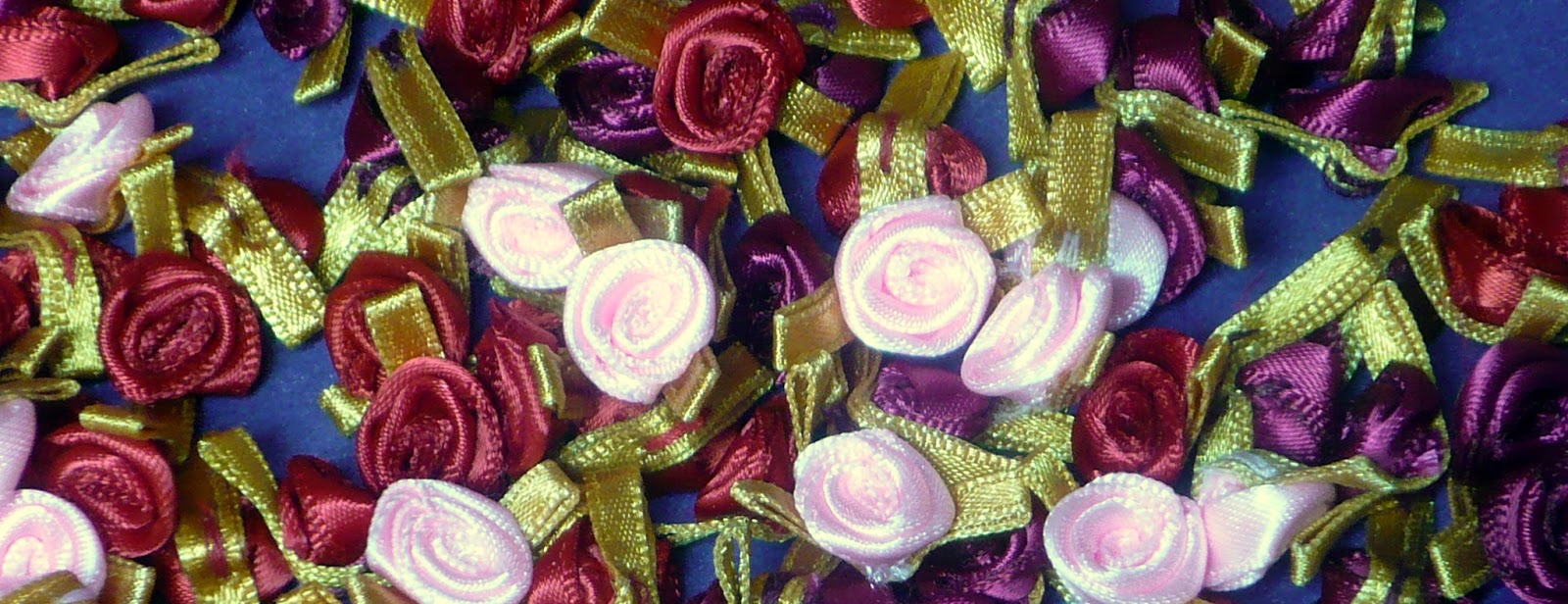


I buy these ribbon roses from Laurl on Etsy.  This small size fits easily through the orifice on my wheel and doesn't get caught in the hooks.  There are larger ribbon flowers available that can be fed through the orifice with lots of care and patience, and although I have at times in my life had sufficient emotional wherewithal to calmly, gently, and successfully ease large ribbon flowers through my wheel workings, this is not something I reliably have in vast quantities, nor do I want to spend it all on my yarn in case that means I'm going to have a complete meltdown later in the day when I burn supper or break my favourite mug.  We live our lives and do what works best, right?  For me, sticking to smaller, more easily dealt-with flowers is the road I have chosen.  My advice is, before starting a project like this, make sure whatever it is you're spinning into your yarn will fit through your orifice and hooks, and consider how willing you're going to be to nurse the yarn along if it's a close fit.


I spun a small sample skein just to see how the colours would play out with the whole hand-drafting the top together method, and also to help me pick what colour flowers I wanted to use.  I think any of these would be nice, but I wanted the flowers to stand out.


Here's my practice skein still on the wheel -- you can see drafting the top as I did worked just fine, and I have random sections of different reds all throughout my yarn ...


... and here are my rose colour choices.  Sadly, the light pink one didn't focus very well, but I think it will stand out best against the reds, and that's what I'm going with.


First step is to thread the roses onto a spool of strong nylon beading thread.  This thread will be strung alongside my strong cotton core in the yarn.


The roses are sewn together across the back, making an ideal spot to run the needle to thread the roses onto the nylon, i.e., between the "leaf" ribbon and the "blossom" ribbon, within the bounds of that stitch.  I took some fabulous shots of the pink flowers being strung onto the nylon.  What in the world happened to them?  I have no idea.  But they've completely disappeared so you're just going to have to use your imagination here.


Now I'm set up for spinning.  Next to me I have a bin with my cotton core (embroidery cotton #10), and another bin with my nylon beading thread.  My comments on this set-up are as follows:

1. You don't need to use two cores.  You can thread all the flowers onto the cotton core.  However, it's a thicker thread and not as slippery, so you have to take more care putting your roses on and sliding them along as you're spinning -- which is okay, I've done it successfully and it's not a terrible drag. It's just easier and smoother with nylon.

2. I thread all the flowers on at once, sliding them a few metres down the thread.  Then I spread out the first five or so flowers where I want them along the nylon.  They tend to stay where I want them, so it's a convenient way to keep track of how far apart they are in the yarn.  I've tried spacing all the flowers out at once, and wound up with a gigantic tangle of nylon in the bin, so just doing a half-dozen or so at a time seems to be the answer for me.  You can see in the photo above, one pink rose hanging on the nylon thread, making its way up towards the wheel to be spun into the yarn.

3. One of the best online tutorials for corespinning yarn that I have seen is by Esther Rodgers of Jazz Turtle.  This is a good video for showing how to start your corespun yarn and introduce the core threads to get going.

4.  Why do I use these ugly plastic bins?  I know.  They're not at all handmade or attractive or anything inspiring creativity.  Here's the thing.  Handmade baskets are tremendously beautiful.  I love them.  But they catch and pick at my materials as I'm spinning, which is not only frustrating but can cause damage.  There are lovely felted baskets which wouldn't do that, but the reality of my life is that I use almost exclusively handprocessed fleece in my yarns.  That means I'm doing a lot of combing and carding, and no matter how much vacuuming and sweeping I do in my craft room, there's always a film of VM (dried crumbs of plant matter) on my floor.  I don't want to even think about what that would do to a lovely felted basket.  Plus I need bins for tons of reasons, including holding uncombed (VM-laden) fleece.  And the ugly plastic ones wipe out easily, are stackable, and sturdy enough that they can hold that huge cone of embroidery cotton in the same place as it's rolling around.  So I forego the aesthetic qualities of more attractive baskets as worktools in this particular situation.


So here we are, corespinning along.  I've just lifted my thumb back to show how I keep the core threads stable in my hand by running them under my ring finger.  My pointer finger smooths the wool around the core as I'm spinning along.


When I get within a few inches of a rose, I stop spinning and slide the flower up the thread to meet the end point of my yarn.  Here I'm holding the two core threads (cotton and nylon) separate, just for the sake of the picture.  When I'm actually spinning, I hold them together.


Fit the rose right up against the wool, treadle once ... 
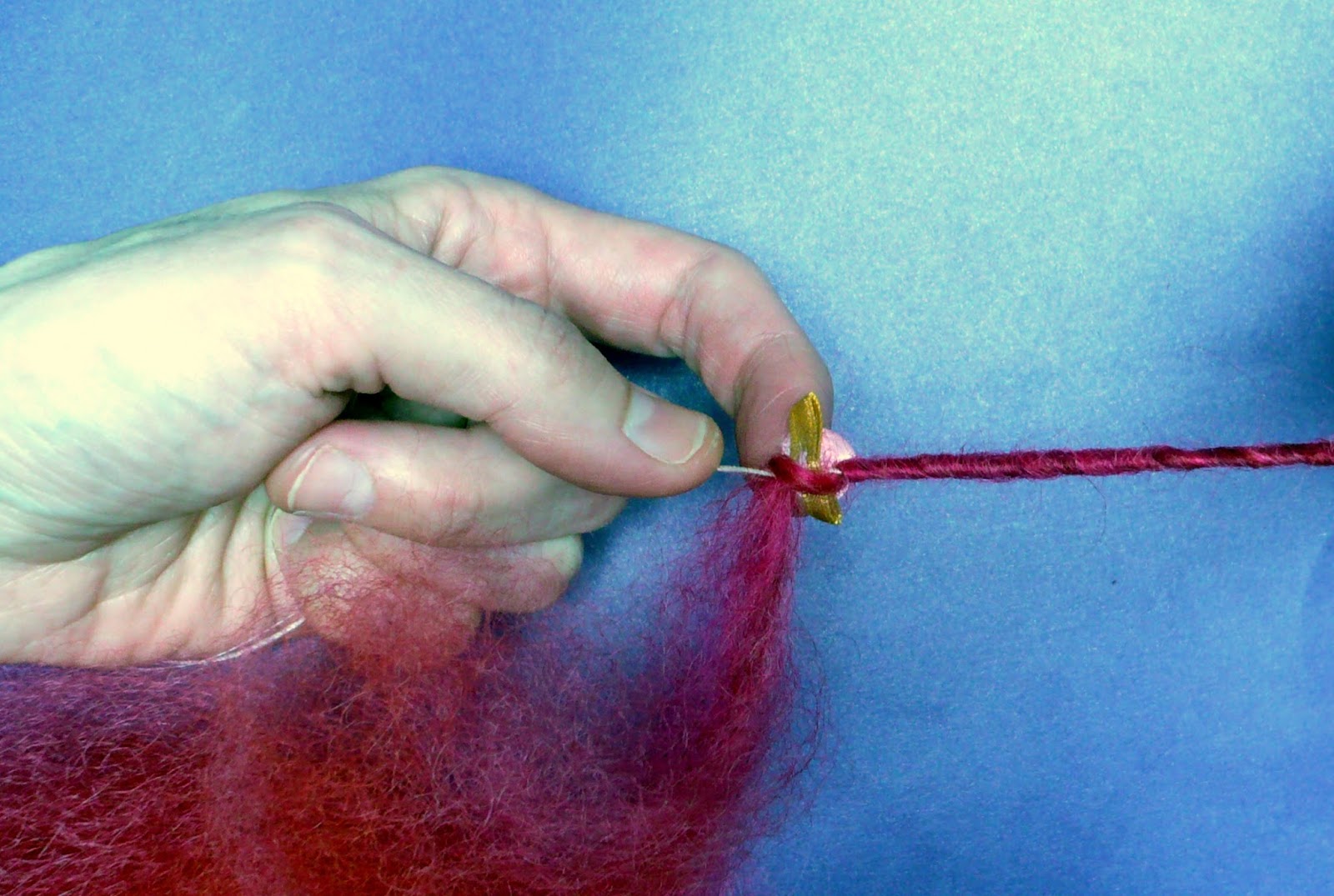


... which wraps the wool around the back of the flower ... 


... and spin on down the core.  Keep an eye on the rose as you continue to spin.  Hopefully it should feed easily through your orifice and onto your wheel, but depending on your wheel it may need a hand -- you'll know right away, because the yarn will stop feeding onto the bobbin.  Just stop spinning, ease the flower through, handwinding it onto the bobbin if necessary, and continue on your way.


Here's a photo of the final yarn, which, taken in my homemade lightbox, shows something much more RED than the pinkish colours above.  It really is these reds, and not those pinks, which teaches us all something about how unreliable cameras are for showing us what anything actually looks like.  Now that's deep.


See this yarn in my ETSY SHOP

Here are some other ribbon rose yarns I've spun - this first one corespun with uncarded locks dyed green, so there's lots of texture and curl.


Available in my ETSY SHOP


In my ETSY SHOP

 In my ETSY SHOP


This was the last skein I spun using larger flowers.  They do look marvellous, and maybe someday when I get my dream larger-orificed Country Spinner, I'll go back to including these flagrant beauties...

24 Jun 2013

What Went Into That Batt - Two Art Yarns

Bulky Two-Ply Yarn HERE
Corespun Yarn HERE on Etsy


 So I've been a bit less than productive recently for various reasons, and thus have fallen a bit behind in both spinning and blogging. Life can get complicated, as we all know.  I'm always appreciative of the calming influence spinning lends to my mental knots.


These two yarns have been sitting in my ready box for awhile.  You can tell they  came from the same family, can't you?  But a different feel, a different heft, different use, and all in the way they were spun.  The fellow up above was plied and one to the right corespun.  One day soon I'll do a little entry on corespinning but this blog is all about putting together the batts they came from.


I was dreaming about some purple yarn, and wanted to use these lovely fleeces, being as they were colours I couldn't resist.  My idea was not to card them, or hardly at all, just run them through the carder along with a bunch of other wool and hopefully keep some of the curl and lock integrity.


Border Leicester/
Bluefaced Leicester Cross
Border Leicester/
Bluefaced Leicester Cross


So for me, designing a batt for yarn involves my starting colour idea (in this case purple) and unloading all my bits of this and that in purple that I've dyed and put away, digging through it all and seeing what I like and what will work and what I feel like using.  Sometimes my idea changes as I find fleeces I'd forgot I had that overpower my initial impulse.  One bag of lovely I found in this exercise had some lovely purple dyed locks that had done me the wonderful favour of fracturing (I do believe that's what happened), which is when the dye kind of splits up into its composite colours. Aren't they great?


These locks were dyed in the same pot, but because I don't stir almost at all during the dying process, they came out very differently from different corners of the pot.  As for the fracturing, that's from the amount of citric acid I used, or the heat, or some chemical issue or other ... dyeing is still a brave new world of adventure for me - I love it! Taking some of the lighter and some of the darker and combing it all together produced the combed top up above.

After I collecting some purples, I cast about for some other colours I felt like adding, and came across some lovely Cotswold I got from Wooly Wool of the West and dyed this fabulous golden yellow.  And there's no coming across something like that in your stash and putting it back again, so into the pile it went.


It's combed into top on the left, and in its curly glory on the right

And then all of a sudden I was hit by grey fever, and absolutely needed some grey - natural grey, the kind sheep grow all by themselves, instead of those rendered grey by me through the magic of Jacquard acid dyes.  In fact, my grey fever was such that I'm going to have to make some grey yarns pretty soon -- all grey with this and that here and there.  But in this particular purple creation, grey will be a condiment.   


Shorter stapled (the staple is the length of each
individual strand of wool), super kinky (that's the crimp)
and oh so soft


Longer staple, more lustrous, soft but not as soft
as the darker fleece


These are both BFL (Bluefaced Leicester)--Shetland cross fleeces from Jody's Little Smoky Blues.  So for those of my friends who are kind enough to read this and don't understand what I'm talking about when I say things like that, a crossed fleece is the result of different breeds of sheep having offspring.  Their wool can have aspects of one or both of the parents to varying degrees.  Look at these very artistic comparisons:
Uncombed locks - quite a difference, even though they're both BFLxShetland
Woolen Fiddleheads - you can tell which combed top
came from which fleece - they're both soft and wonderful to spin,
but the left is more lustrous, and the right is softer


But oh my, because now your eyes have seen so much grey it's hard to remember what we're aiming for.  Maybe it will come back if you see all the combed and carded fibre ready to be put together into a lovely batt -- and a batt is made when you card (kind of like brushing) together wool so it more or less is kind of all running in the same sort of direction.  Not perfectly, but more or less.  You can do these with locks of wool to help open them up and make them easier to spin (like brushing your hair makes it easier to get a job, maybe) or with wool that's already carded or combed to mix together colours and amalgamate it all together.


Lovely purples nestled in amongst my golden Cotswold, some red Romney lamb locks and golden-orange Border Leicester x BFL (and now you know what the X means), my purple locks that started it all, and my grey-fever greys, which also includes some uncarded locks there on the left


This went only once through the carder
to maintain texture and colour integrity
to a certain extent


Now for carding fun - I wish batts were easier to see in photographs -- you can never see very much of a batt in one shot PLUS for me, I just have to touch everything so just looking can be very frustrating... At any rate, I got a lovely mix of purples for depth and subtle shifts in purpleness, plus kapows of other colours all throughout.


Now it's time to spin.  For my plied yarn, I spun one ply -- a thicker one -- from the batts I made here:


This is a strip from the batt (I just pulled away a strip of wool straight through the 
thickness of the batt) alongside my yarn still being spun on the spindle

The second batt, and the wools that went into it - I carded this twice, to blend the colours more.  The dark burgundy in the middle is actually a blend of BFL and silk - the only mill-carded wool I used

Then I needed a second strand of yarn to ply (twist together with) the first.  I wanted it thinner and less poppingly colourful, so I carded together the wools on the right to get the batt here on the left, and here it is below on my wheel being spun:


 Plied (or twisted) (or spun) together:

Fibres include Romney x Merino, Corriedale, Cotswold, Romney lamb, Border Leicester x Bluefaced Leicester, Bluefaced Leicester, Bluefaced Leicester x Shetland, Silk


And here below is the corespun yarn, a blog entry about this method of spinning is in my future.  Very quickly, in spinning this kind of yarn, the wool is wrapped around a central yarn (or core) of some type, so the angle of wrapped fibres is different than the twist of regular yarn, the colours show up differently and the yarn hangs and works differently.  


Now that you've seen where they came from, here are my yarns again, washed and dried and ready to go:


Plied Yarn available from my Etsy shop - a 47-yard skein, super bulky at 3-4 wpi

Super bulky, as you can see!

And here's the corespun with bright zinging colours - also in my Etsy shop
this one is  60 yards long, and chunky weight (5-6 wpi)

12 May 2013

Experiment - Navajo Ply with inclusions, Plied Twice. Plus ME trying out blogging.

It's spring, so sheep are getting sheared and people like me who love new fleece are enjoying their Laughing Place.  I've been doing a fair bit of washing lately -- which I love to do, believe me, not just because of what's waiting when it's all done, but the whole process just feels good somehow -- but it's hard to resist taking a break to play.  And why resist, after all?  The dirty fleeces still waiting aren't going anywheres.

I was in the mood for BLUES, and now that my husband found me a second slow cooker sitting out on someone's curb the day after a neighbourhood yard sale (thank you everyone for not buying it), I can dye twice as much at a time. I like slow cooker dyeing because the fleece doesn't get disturbed in the dye bath and doesn't felt.  

There they are drying:
From top left clockwise: Romney x Merino, Cormo,
Border Leicester x BFL, BFL x Romney/Cotswold

From top left clockwise: Cormo, Lincoln Longwool,
Romney x BFL, Border Leicester x BFL
 Can't resist showing off the lock loveliness -- don't you just want to do something fabulous with all this gorgeous blue?

RomneyxBFL, Cormo, Lincoln Longwool, BFLxRomney/Cotswold, BLxBFL, RomneyxMerino, RomneyxMerino

I recently watched a few YouTube ads for an Ashford Country Spinner (my dream wheel) featuring Steph Gorin from Loop doing cool things (I love it when people share their ideas and give tutorials for free -- so generous with their talent!). In this particular video, she Navajo plies corespun yarn, inserting locks and various other items, then teardrop plies the whole thing.  

Sounds fun.  Seeing as my wheel is significantly smaller than a Country Spinner (I have an Ashford Traditional with a jumbo flyer) I thought I'd try something of what she did, but smaller.  Also, no non-wool insertions; I'm going to stick with locks.

I've been getting really into combing. It's so luxurious.  I even comb first when I'm going to card batts.  I just love the wool top when you pull it off.  The locks weren't all the same length, but close enough.  I don't think things necessarily have to be perfect in this department.  They carded beautifully and soon I was spinning my corespun.

Ready on my combs


After two passes with the combs:


                                                And pulled off in top:                        


I love love love the blues, and decided for a nice pow of colour to use some green locks to ply in -- these are all BFL-cross fleeces, except the far left, which is Cotswold.  


First catch the locks into the loops of your yarn as you Navajo-ply it ...


Then ply the whole shebang - this is plied on a bright blue mill-spun wool yarn with silver and purple metallic thread autowrapped.  It hasn't been washed yet in this pic, it's straight off the wheel.


A great weekend project, I think, very enjoyable accompaniment to the murder mysteries I usually listen to whilst spinning.  I'm not quite done -- either the skein or the mystery -- and it looks like this is going to fill my spindle twice over once it's all plied together.  But I like the yarn, very chunky and textured and I love the colours and what the locks do after the second ply.  Still thinking of blues, though.  I think I'll be delving into these fleeces again for my next skein.

(LATER)

Here's the yarn, washed and set - as you can see in the second photo, it's super bulky (2-3 wpi) and all told about 19 yards long.


You can see it in my shop here


In my Etsy shop