Showing posts with label Faroe Islands. Show all posts

11 Aug 2014

Weaving with Faroese Wool: An unfinished blanket story

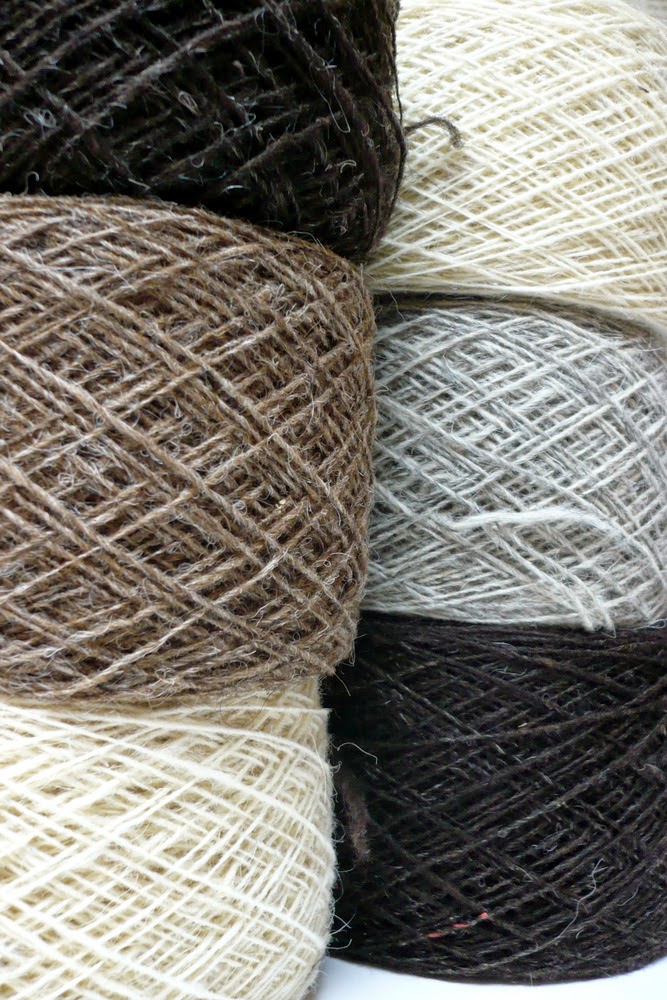
Something else I've been keeping busy with this past year is a project I've been meaning to get around to for a long, long time.  Some years ago on a trip to the Faroes I bought several skeins of very fine-weight Faroese wool singles (unplied wool, 6,000 m/kg).  It's spun in the natural colours of the sheep, and they leave in a fair bit of lanolin so the skeined yarn is kind of stiff-ish.  I'd bought yarn there in the past for a sweater, and when I got it from the store the white yarn was almost yellow and it felt -- well, it felt and smelled very lanoliny.  Not a bad smell -- actually, I like it -- but not generally what you expect from store-bought yarn.  It was easy to work with, however, and once my sweater was finished and washed the wool was snowy white, beautiful, and oh so warm.

Spools of Faroese yarn against the border of my blanket
I wanted to do something different this time, though, something woven and blanketish, so I got the superfine singles instead of heavier sweater yarn. I thought the extra lanolin would make the yarn really easy to work with on the loom. And aren't these colours amazing?  Speaking as someone who loves dyeing wool and coming up with new kinds of purple, I have to say I am mesmerized by the natural beauty of these browns and greys and how they look together.


The yarn company is called Sirri. Here's their label:


It's impossible not to notice in the Faroes that the people there are very connected to their land and their history.  It's one way they have managed to continue to preserve their language and culture, which in these days of Internet connectedness and general homogenization would be so easy to lose.  I can't help thinking this pride in their heritage is evident right in the yarn label, which itself is very (to me) charming, printed in brown ink on light brown handmade-looking paper.


And I love the nostalgic poem on the back - I wish I could understand the Faroese; it's probably better than the English translation.


So back to the wool.  Standing in the store hovering over the bins of yarn, I didn't have a plan in mind.  I just saw yarn I loved and wanted to have and use, with no possibility of going away, thinking a project through, and returning later to make a purchase.  So I just got several white skeins and then one or two each of the other colours and left the planning until later.  

When I got home and turned my mind to it, however, and really checked out the yarn, I found that it wasn't going to make a good warp.  A basic warp strength test is to take a length of yarn and give it a yank to see if it holds together.  This yarn pulled apart easily.  Really easily.  It was kind of devastating, because I had my heart set on weaving with it.


Something else I had to come to terms with was the fact that it really wasn't very soft.  In fact the opposite; it's pretty scritchy.  In this close-up below of the strands of yarn -- the four on the right are my Faroese wool -- you can see how they might not be entirely soft, with those thick strands of wool sticking out.  Some of the Faroese yarn wasn't very evenly spun, as well -- which is okay, much of my weaving and spinning involve yarns that aren't evenly spun.  It gives an effect to the finished work that I really like.  Still, in some places it got really very thin, and I knew I'd have to do some finagling to keep the yarn intact in the weaving, lest the structural integrity of the fabric be compromised.

Yarn on the left - Alpaca/Silk 2/14 yarn from Maurice Brassard - the warp
Four yarns on the right - my beautiful Faroese yarns - the weft
So I was going to need a warp, and I wanted something about the same thickness as the other yarns, but much stronger and hopefully much softer to offset the scritchiness of the coarser Faroese wool.  I chose this Alpaca-Silk yarn from Maurice Brassard.  I hoped it would show off the colours of the weft nicely - although more subtly with the white.


The chosen warp -- the "white" Faroese yarn looks creamy yellow in comparison, because of the lanolin left in the wool

I'd decided to weave a twill pattern both for a nice hang to the fabric, and because there are so many patterns to choose from that would allow a colour contrast between weft and warp threads.  Because of the width of my loom (45") I was going to weave the blanket in panels and sew them together.  Rather than trying to match stripes of weft colour changes in the panels, I decided to plan "random" stripes of solid colour that wouldn't align. As I looked at patterns I became fascinated with trying an undulating twill -- which, as the name suggests, is a twill with a wavy effect in the pattern.  In the end I chose one from Anne Dixon's Handweaver's Pattern Directory, on p. 199, changing the treadling with each colour change.  I sett the 2/14 warp yarn at 15 epi for a light, airy fabric.


At each end of the panels I wove a stripe with the warp yarn.  You can still see the pattern, even white-on-white.  Because the fabric on the loom is under tension, there are holey gaps.  Once it's off the loom and washed, those holes mostly disappear or at least get considerably smaller as the threads come together and form a piece of cloth.


Off the loom and washed

It wove up fast and as always it was a joy to see the pattern reveal itself in the contemplative back and forthing of the shuttles.  I love the way the undulating pattern gives a depth to the fabric.  I'll definitely be exploring undulating twills in future projects.  There are some really nice ones in Helene Bress's The Weaving Book.


Unfortunately, the white Faroese wool wound up washing so white after I got it off the loom that there's very little contrast with the warp.  Still, you can see the pattern, and the fabric is really light and airy just as I'd hoped.  It will be a lightweight but warm blanket.  In places where the weft yarn was spun really uneven and got too thin for comfort, I broke off the yarn, cut out the thin part, then picked up where I left off.  I probably had to do that 10 or 12 times altogether, but only with the dark brown wool, so I wonder if it was just a bad batch or something.


Close up you can see what makes the undulating pattern: the warp threads are sometimes grouped or repeated in twos and threes through the same shaft, instead of changing shaft with each thread.  In those places the angle of the pattern lines made by the weft changes to a more gradual slope, giving a wavy effect.


Because of a really ridiculous math mistake in calculating how much weft yarn I had, there's loads and loads of yarn left over.  I can easily weave two more panels for a larger blanket, so I think that's what's going to happen.  The alpaca-silk was wonderful to work with as a warp -- soft and strong -- so I'll get more of it for the other panels, but I think I'll get a light brown colour for more pattern contrast with all four of the weft yarns, and when I sew the panels together I'll alternate them white-brown-white-brown. 

The vagaries of photography turned this white fabric silver - ah well, at least the pattern shows up well!
So this is an unfinished tale -- I have two more panels in my blanket left to go.  That means it won't get done until I finish my current exciting project which I have yet to write about, and then some tea towels I have in mind that I'm looking forward to doing, then possibly a bath towel, and then a blanket for my son in natural grey handspun, then, hopefully, there will be time ...


28 Jul 2013

Framing Tapestries or Lucky to have a Folk Artist Sister

I do love weaving tapestries, although it's awhile since I've indulged in that particular pleasure.  I wanted to share a great framing idea for small pieces -- anything lightweight enough not to sag between the hangers -- as well as my "usual" method for larger hangings.

I'd been experimenting with incorporating only certain warp threads into the weft, and letting others float above the weaving to add colour and texture to the image.


Fish tapestry, 16.5 cm x 11.5 cm (6 1/2" x  4 1/2")
Every second warp thread is left loose to float above.  I used a piece of paper to separate
the warp threads, flipped the loom over and wove the background from the back.
Then I flipped the loom over again to weave the fish into the floating warp threads,
and with a bundle of metallic threads did some free-form weaving to gather
the loose warp threads and give it a wavy, watery look.  The little purple guys were too small 

to hold their shape.  If you get far enough away and squint, they look fish-ish -- now I think of them 
as floating blurbles and have made peace with them.


Dragon tapestry, 18 cm x 10 cm (7" x 4")
I alternated green boucle and blue warp threads, weaving the blue into the bottom half
of the tapestry and letting the green float, and vice versa for the top half, using paper to keep
the threads separate, as for the fish.  The border edges weave in all the warp threads.
The tree is woven into the floating warp threads, and the dragon is embroidered
into the whole piece.


Here's another look at my fishie and dragon:


The dragon is the avatar I use for my Etsy shop

But how to hang these little guys?  I didn't want a permanent frame, because life is too rife with unforeseen circumstances to gamble so flagrantly, so no gluing or anything like that.  They're only small and lightweight, and I didn't want them to disappear on the wall by hanging them the usual way. 

And what's the usual way? you may ask.  Simple but effective: sew the fuzzy side of a length of velcro across the top of your tapestry.  Staple the sharp toothy side onto a length of narrow wood.


Sewing the velcro onto the tapestry can be hard on your fingers - it's tough to make
the needle go through that heavy velcro material.  However, I do not suggest
using stick-on velcro as an alternative.  The glue just isn't strong enough,
unless you have a very light-weight tapestry. And even so, I don't think it lasts long enough.

I guess you could machine-sew it onto the backing fabric before you sew it onto the
tapestry, but you'd have to be pretty exact in your measurements, as well as have the forethought
to do that bit first, which thus far in my life I guess I haven't...


Screw hanging loops into the top edge of the wood, and hey, presto! A perfectly hung tapestry - or at least a tapestry ready to be perfectly hung.


If the hanger is exactly as wide as your tapestry, there won't be any sag

I learned to do this from my tapestry instructor, many, many a year ago now, given away by the year I have stitched onto the back.  And the example I'm showing you is my first ever tapestry, woven in that very class.  Here it is from the front:


Troll in the Moonlight - my first weaving endeavour 46 cm x 43 cm (18" x 17")
I was inspired by Faroese folktales in choosing my subject.


I loved making this; it totally turned me onto weaving. Here he is close up, gazing pensively at the rising moon ...


The entire piece is woven, except I top-stitched on the black outline of the troll.
We learned yarn dyeing in that class as well, and I wove the sky out of yarns we dyed ourselves.


But back to the issue at hand.  My dragon and fish tapestries are much smaller than my troll, and I wanted an actual frame to help them stand out when they were hung.  This would save my fingertips from sewing on velcro, but still, what to do?  

Luckily, I happened to mention this quandary to my sister Kathi, who is a folk artist (Pufferbellies) and good with wood.  She made two great frames that are perfect - although admittedly you have to have some woodworking tools to make them just the way she did.


Each frame measures 29 cm x 24.5 cm (11 1/2" x 9 1/2"),
the centre area where the tapestry is mounted is recessed about 1/2 cm (1/4").

I love the way she painted the frames with layers of colours,
and the contrasting recessed centre that shows up the piece

They're two separate pieces of wood, the 1.5 cm-thick outer frame, and a thin piece of plywood mounted in the centre like a photograph in a frame.  


Aha, a secret glimpse of my high-tech homemade cardboard lightbox...

The tapestries are actually tied onto the recessed centre piece of plywood.  This is why I don't think it would work with heavier tapestries, because you would risk it sagging between the ties, or even being too heavy for the plywood to hold, depending on the size of the piece.


She drilled holes in the plywood to tie on the tapestries, which I did with strong upholstery thread.

Here they are from the back:


The plywood is held in place using those metal tabs used in photo frames.
With no woodworking skills or no access to tools, however, you could do something
simpler, just using the thin painted plywood and tying your piece onto the centre,
and then creating your own outer frame (out of felt, or woven pieces, or paper, or
more painted plywood) and gluing it onto the plywood around the piece.
Something quick and dirty would be to just buy a photo frame, punch holes 

in the cardboard backer, and sew the tapestry onto that.  You've lost
the handmade aspect of the frame, but sometimes you do what you have to, right?

Painting the back of her work is just one of those touches Kathi likes to add, and which I love.
The knot is just a reef knot so it's easy to untie if I ever need to.
And just for fun, here are some other tapestries I made a few years ago.  

This was my first experiment with floating warps, where I incorporated a frame into the picture - taken pre-lightbox, unfortunately, so the colours are all bleached and the picture quality is kind of lousy.  I gave the tapestry away so I can't re-photograph it...

The fish was woven with sari-silk yarn.
As I recollect, the piece measures about 25 cm x 25 cm (10" x 10")

And a couple other weaving experiments, also photographed sans lightbox some time ago ...


Pilot whales frolicking around the Faroe Islands - this was 40 cm x 40 cm (14" x 14")
Again, playing with incorporating the frame into the piece.

Fog creeping to a standing stone - the ground is sari-silk yarn, 40 cm x 15 cm (14" x 6")