Showing posts with label wool blankets. Show all posts

11 Aug 2014

Weaving with Faroese Wool: An unfinished blanket story

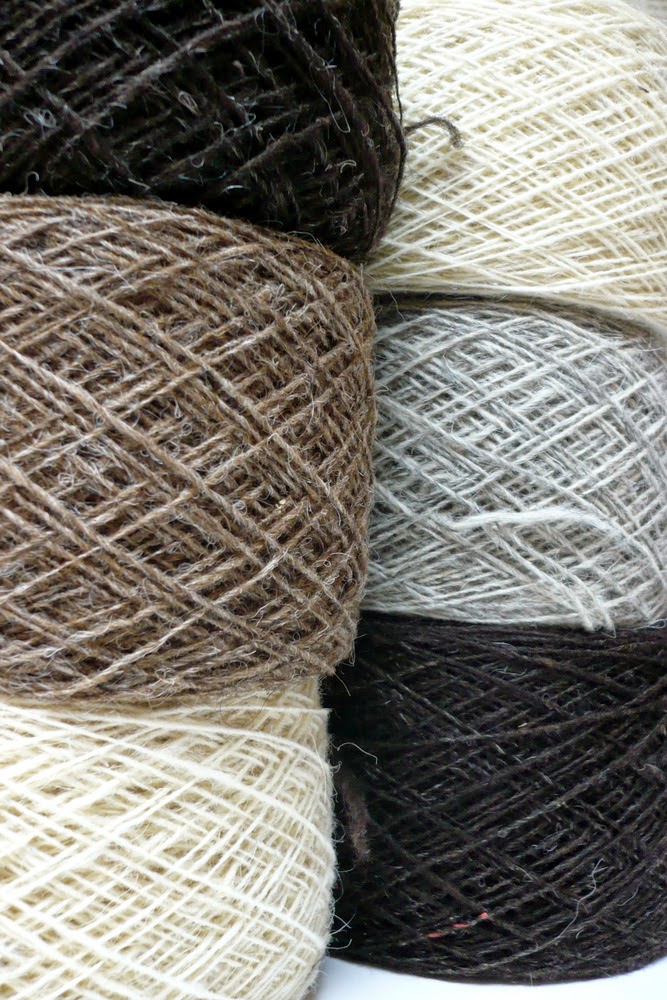
Something else I've been keeping busy with this past year is a project I've been meaning to get around to for a long, long time.  Some years ago on a trip to the Faroes I bought several skeins of very fine-weight Faroese wool singles (unplied wool, 6,000 m/kg).  It's spun in the natural colours of the sheep, and they leave in a fair bit of lanolin so the skeined yarn is kind of stiff-ish.  I'd bought yarn there in the past for a sweater, and when I got it from the store the white yarn was almost yellow and it felt -- well, it felt and smelled very lanoliny.  Not a bad smell -- actually, I like it -- but not generally what you expect from store-bought yarn.  It was easy to work with, however, and once my sweater was finished and washed the wool was snowy white, beautiful, and oh so warm.

Spools of Faroese yarn against the border of my blanket
I wanted to do something different this time, though, something woven and blanketish, so I got the superfine singles instead of heavier sweater yarn. I thought the extra lanolin would make the yarn really easy to work with on the loom. And aren't these colours amazing?  Speaking as someone who loves dyeing wool and coming up with new kinds of purple, I have to say I am mesmerized by the natural beauty of these browns and greys and how they look together.


The yarn company is called Sirri. Here's their label:


It's impossible not to notice in the Faroes that the people there are very connected to their land and their history.  It's one way they have managed to continue to preserve their language and culture, which in these days of Internet connectedness and general homogenization would be so easy to lose.  I can't help thinking this pride in their heritage is evident right in the yarn label, which itself is very (to me) charming, printed in brown ink on light brown handmade-looking paper.


And I love the nostalgic poem on the back - I wish I could understand the Faroese; it's probably better than the English translation.


So back to the wool.  Standing in the store hovering over the bins of yarn, I didn't have a plan in mind.  I just saw yarn I loved and wanted to have and use, with no possibility of going away, thinking a project through, and returning later to make a purchase.  So I just got several white skeins and then one or two each of the other colours and left the planning until later.  

When I got home and turned my mind to it, however, and really checked out the yarn, I found that it wasn't going to make a good warp.  A basic warp strength test is to take a length of yarn and give it a yank to see if it holds together.  This yarn pulled apart easily.  Really easily.  It was kind of devastating, because I had my heart set on weaving with it.


Something else I had to come to terms with was the fact that it really wasn't very soft.  In fact the opposite; it's pretty scritchy.  In this close-up below of the strands of yarn -- the four on the right are my Faroese wool -- you can see how they might not be entirely soft, with those thick strands of wool sticking out.  Some of the Faroese yarn wasn't very evenly spun, as well -- which is okay, much of my weaving and spinning involve yarns that aren't evenly spun.  It gives an effect to the finished work that I really like.  Still, in some places it got really very thin, and I knew I'd have to do some finagling to keep the yarn intact in the weaving, lest the structural integrity of the fabric be compromised.

Yarn on the left - Alpaca/Silk 2/14 yarn from Maurice Brassard - the warp
Four yarns on the right - my beautiful Faroese yarns - the weft
So I was going to need a warp, and I wanted something about the same thickness as the other yarns, but much stronger and hopefully much softer to offset the scritchiness of the coarser Faroese wool.  I chose this Alpaca-Silk yarn from Maurice Brassard.  I hoped it would show off the colours of the weft nicely - although more subtly with the white.


The chosen warp -- the "white" Faroese yarn looks creamy yellow in comparison, because of the lanolin left in the wool

I'd decided to weave a twill pattern both for a nice hang to the fabric, and because there are so many patterns to choose from that would allow a colour contrast between weft and warp threads.  Because of the width of my loom (45") I was going to weave the blanket in panels and sew them together.  Rather than trying to match stripes of weft colour changes in the panels, I decided to plan "random" stripes of solid colour that wouldn't align. As I looked at patterns I became fascinated with trying an undulating twill -- which, as the name suggests, is a twill with a wavy effect in the pattern.  In the end I chose one from Anne Dixon's Handweaver's Pattern Directory, on p. 199, changing the treadling with each colour change.  I sett the 2/14 warp yarn at 15 epi for a light, airy fabric.


At each end of the panels I wove a stripe with the warp yarn.  You can still see the pattern, even white-on-white.  Because the fabric on the loom is under tension, there are holey gaps.  Once it's off the loom and washed, those holes mostly disappear or at least get considerably smaller as the threads come together and form a piece of cloth.


Off the loom and washed

It wove up fast and as always it was a joy to see the pattern reveal itself in the contemplative back and forthing of the shuttles.  I love the way the undulating pattern gives a depth to the fabric.  I'll definitely be exploring undulating twills in future projects.  There are some really nice ones in Helene Bress's The Weaving Book.


Unfortunately, the white Faroese wool wound up washing so white after I got it off the loom that there's very little contrast with the warp.  Still, you can see the pattern, and the fabric is really light and airy just as I'd hoped.  It will be a lightweight but warm blanket.  In places where the weft yarn was spun really uneven and got too thin for comfort, I broke off the yarn, cut out the thin part, then picked up where I left off.  I probably had to do that 10 or 12 times altogether, but only with the dark brown wool, so I wonder if it was just a bad batch or something.


Close up you can see what makes the undulating pattern: the warp threads are sometimes grouped or repeated in twos and threes through the same shaft, instead of changing shaft with each thread.  In those places the angle of the pattern lines made by the weft changes to a more gradual slope, giving a wavy effect.


Because of a really ridiculous math mistake in calculating how much weft yarn I had, there's loads and loads of yarn left over.  I can easily weave two more panels for a larger blanket, so I think that's what's going to happen.  The alpaca-silk was wonderful to work with as a warp -- soft and strong -- so I'll get more of it for the other panels, but I think I'll get a light brown colour for more pattern contrast with all four of the weft yarns, and when I sew the panels together I'll alternate them white-brown-white-brown. 

The vagaries of photography turned this white fabric silver - ah well, at least the pattern shows up well!
So this is an unfinished tale -- I have two more panels in my blanket left to go.  That means it won't get done until I finish my current exciting project which I have yet to write about, and then some tea towels I have in mind that I'm looking forward to doing, then possibly a bath towel, and then a blanket for my son in natural grey handspun, then, hopefully, there will be time ...


9 Aug 2014

Weaving Blankets with Stash Yarns

I've been busy weaving blankets and towels these past months, mostly mostly working on one major project, a taste of which I present below.


Right now on my loom, luring me away from my desk to weave a bit more ...

But first things first.  This entry is about what I was weaving BEFORE I started what you see in that picture above.  I've been so taken up with my projects and life in general that I have been neglecting to share my experiences with the outside world.

I inherited my grandmother's counterbalance loom some years ago, a Fanny Leclerc.  I love this loom.  It is special to me because it was Grannie's and she was one pretty amazing person.  Sometimes when I'm weaving, I feel like I'm visiting with her.  I often wonder what she would think of what I'm getting up to.  I'm pretty sure she'd shake her head and laugh.

Much as I loved this loom, it is old enough not to have a shed regulator.  Even though it's possible to do many, many things on a counterbalance loom without one, I kept finding things I wanted to try that I couldn't, and it was always on my mind that if only I had a shed regulator it would be sooo perfect  and how will it be possible to survive without one ...  so this year I got an excellent birthday present ...


The shed regulator is added onto the top of the loom - all the lighter-coloured wood - to allow for an uneven shed, so instead of always raising combinations of two shafts, I can now raise just one or three.  A shame the wood colour doesn't match perfectly, but given that it's been added a good 50 years after the loom was bought, it's amazing that Leclerc has kept their specifications so perfectly that I can buy a new piece this way.  Also, the different colours remind me of my loom's history.

... and I am pleased. I can't figure out why it works, but then I don't really understand why or how my telephone works, either.  I just accept it and am thankful.

I was finding my yarn stash was becoming a little overwhelming, and I decided to weave some small blankets.  We don't overheat our house in the winter, and at night curling up in front of the TV it's nice to have a blanket to get cozy under.  I figured it would be a fun way to experiment with putting colours together and seeing how different yarns behaved on the loom.  

It's not the first time I've done this.  There's this throw blanket I made entirely from small skeinlets of leftovers.


The warp is mostly leftover Harrisville with a bit of other yarns thrown in.  It was so fun just randomly choosing my next stripe and weaving until I wanted to start something new.  It's not huge, just big enough for a 10-year-old to lie down under, and plenty large to wrap around a big person.


I also did an all-yellow experiment, a giant shawl made from taking out my box of yellow yarns and just following my heart.  I love yellow; it's always been one of my favourites.


Closeup of the shawl - I mixed fibres as well as yarn types.
Not woven too tight, so it has a nice drape.
It's much brighter in real life, I just can't capture it with our camera.

As I went through my stash looking for inspiration, I came upon several balls of lopi a friend of mine gave me from a Fair Isle sweater that she'd always intended to make but never did.  I'd never used lopi as a warp before, and was a bit leery that it would just break, given that it's spun with such a low twist.  It worked just fine (although there was a lot of lint on the floor under the loom by the time I was finished).  


There were two colours, navy blue and a dusty turquoise-green.  The challenge was designing a blanket that didn't need more warp than I had from the sweater yarn.  I alternated the colours in six-inch stripes, sett at 6 epi.  I love the difference in the weft colours as they move from one warp stripe to the next.  It totally changes what they look like.  Amongst the weft yarns you can see here are a few skeins of Noro yarn and some handspun.


The blanket was woven in two panels each 23 inches wide.  The centre of this photo shows the seam where I sewed them together to make the blanket.
I used a skip twill pattern because I wanted to show off the colours more than the actual patterning of the weaving.

After washing, the yarns really pulled together nicely into the blanket fabric.
It's really warm and solid but has a nice drape, so I think the sett of 6 epi worked out okay.

It's just the right size for laying down under on the couch.  I guess some sweaters were never meant to be.

I also had a whole lot of pinks in my stash, most of it Briggs & Little that I had picked up here and there.  They made the warp in my next project.
Different pinks of about the same weight.  I'm pretty sure that pink and grey yarn on the front right  is from my first tapestry weaving class when our instructor was teaching us to dye yarn.
For the weft I picked out several skeins of beautiful, soft yarns I'd gathered over the years. There's a lot of Misti Alpaca yarn of various sorts


as well as some gorgeous baby llama boucle handpainted by the Fleece Artist (top left), some lopi in a fabulous pink left from a sweater I made as a teenager (what ever happened to that, by the way?  I loved that sweater! I'm sure I lent it to one of my sisters....) and some handspun.  I couldn't wait to put all these colours together.  


I wove the blanket in two panels 32 inches wide in a skip twill, with a warp in random stripes of pink.  I changed weft colours at my whim.


Given that the whole point of this exercise was to use up stash yarn, I'm really happy with the colours.  If I were starting out fresh, I probably would have used something else for the warp - the colour I had the most of could have been better.  Still, it's a great blanket, very snuggly and just the right size for a single bed.  My daughter loves it.  

This photo shows the seam running up the middle of the blanket between the two panels.
One comment I would have is that I'd never used Misti Alpaca yarns before.  I bought those skeins because I saw them somewhere for a good price and couldn't resist the colours.  I have to say now that the blanket is in use, they pill and shed outrageously.  It's actually remarkable how much fibre that blanket loses from those yarns.  They make for super-softness, and they're lovely to hold and work with, but I don't think I'll use them on anything practical in the future.

Now time to get back to my loom and the current project I showed you at the top, which I've been working on a full year now ... that blog entry coming soon ...